News
Dübendorf ZH – Agile Wind Power’s wind turbines have achieved high efficiency in initial, still preliminary measurements. Even with uncontrolled rotor blades, it is at least as high as calculated. For controlled rotor blades, it is likely to be even higher.
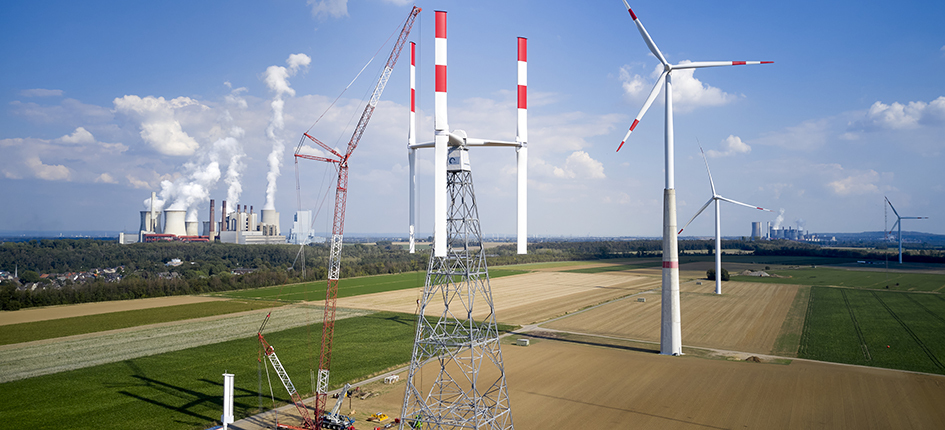
Agile Wind Power has developed a vertical wind turbine that allows individual positioning of each rotor blade. This allows the individual blades to be automatically adjusted to the wind direction. This results in high performance even at low rotation speeds, while the load on the plant structure remains low. At the same time, noise emissions are reduced to around one third.
According to a company statement, initial measurements have now shown that the efficiency of the uncontrolled wind turbine is also at least as high as calculated, and possibly higher. The efficiency of the turbine with controlled rotor blades is likely to be significantly higher again.
Agile Wind Power's wind turbines are suitable for distributed generation of electricity, especially in industrial and commercial areas where large wind turbines are not acceptable. "Vertical Sky for on-site wind power generation offers a unique solution to a large need," Patrick Richter, founder and CEO of Agile Wind Power, is quoted as saying in the release. "Dramatically shortening project timelines through the benefits of a low-speed wind turbine, such as near-silent motion and protection for birds, opens up a huge unsaturated market."
Agile Wind Power's first products, the A32 and A42 turbines, have rated outputs of 750 and 1500 kilowatts, respectively. The A42 turbine reaches a height of 99 meters. The rotor has a diameter of 42 meters, and the three rotor blades each have a length of 50 meters. The plant is designed for wind speeds between 2.5 and 24 meters per second. stk
News
Zurich – Zurich-based fintech Relio has raised CHF 3 million in a financing round. TX Ventures from the TX Group acted as the leading investor. The funds will be used to launch a digital payment account for business customers.
The Relio AG has raised a total of 3 million Swiss francs from several investors in a financing round, informs the TX Group in a Communication. Your venture capital company, TX Ventures, acted as lead investor in the financing round. In addition to the TX subsidiary, which specialises in investments in fintechs, the financing round included. SIX FinTech Ventures and the High-Tech Gründerfonds involved.
Relio AG intends to use the funds to introduce a digital payment account for corporate customers. The Zurich-based fintech has developed an algorithm that performs compliance checks "quickly, accurately and automatically," even for large companies, according to the statement. This should help digital banks reduce the time required for due diligence when opening accounts for corporate customers.
Krzysztof Bialkowski, Managing Partner at TX Ventures, is excited about his company's entry into Relio. He firmly believes "Relio's experienced team is capable of shaping the future of SMB banking by automating and improving what is central to all banks: compliance," Bialkowski is quoted as saying in the release. "This will enable the startup to bring real innovation to the market by improving administrative processes and supporting even the most complex SME customers in Switzerland and abroad." hs
Author: hs, Café Europe
Image Source: Relio AG

News
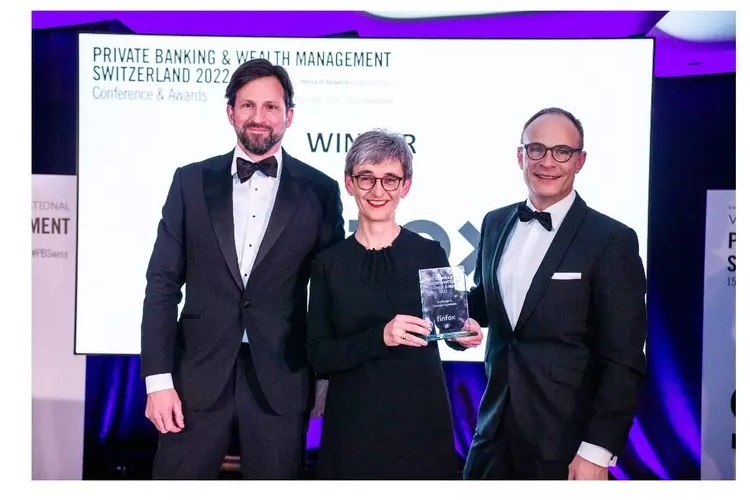
We are delighted to announce that Finfox won the Excellence in Customer Experience award at the Private Banking & Wealth Management Switzerland Awards 2022. In addition, Finfox had been nominated in the category Outstanding Wealth Management Technology Provider in Switzerland – (Vendor). The winners were revealed on 15th December during a gala awards ceremony at The Dolder Grand in Zurich.
The Private Banking & Wealth Management Switzerland Awards recognise outstanding achievement in the fields of Private Banking and Wealth Management in the Swiss market since 2018. The Excellence in Customer Experience award honours software and technology solution providers that enable private banks and wealth managers to offer a first-class customer experience to their clients.
The laudation stated: “With Finfox, advisers provide their clients with an extensive and high-end spectrum of user journeys ranging from adviser-led solutions to easy-to-use guided self-services, thus always keeping abreast with the clients’ situation within the overall client lifecycle.”
Dr. Christian Dicke, CEO at Finfox: «We are proud to have been able to demonstrate how Finfox improves our clients’ wealth management experience. For us, excellence in customer experience means creating memorable moments with a visible added value for the client. That is at the heart of what we strive for every day.”
«Being recognised in this way proves that with FinfoxTouch, our tablet-based advisory tool, and FinfoxAdvice, our tool for guided self-services, we extended our product proposition effectively. It shows that we are successful in providing our clients an experience that exceeds expectations in terms of ease of use and functionality,” he continued.
“I want to congratulate everyone at Finfox for this outstanding team effort and thank our clients for choosing Finfox on their digital transformation journey,” Christian Dicke concluded.
News
Patrik Deuss has developed intelligent light sources that work very efficiently. What began with a bachelor’s thesis in the energy and environmental engineering program at the ZHAW is five years later a startup with 42 employees. LEDCity’s goal is to save enough electricity in lighting by 2030 to reduce the need for nuclear power plants.
Where is the greatest potential for stopping climate change? This was the question on Patrik Deuss' mind when he was looking for a topic for his bachelor's thesis in energy and environmental engineering. In heating? In mobility? In the lighting? "In the ZHAW buildings, I noticed that the lights in the corridors were always on," says the energy and environmental engineer. "The janitor explained to me that lighting control is a complex issue." Conventional systems have a single motion detector per room and can only light it completely or not at all. "It should be possible to do this more in line with demand," thought Deuss - and he had found the topic for his bachelor's thesis.
The ZHAW student began developing the prototype of an intelligent light source. His idea was to switch from a centralized to a decentralized system: each illuminant should have its own "brain". The sensor in the new LED tube measures not only movement, but also temperature, humidity, and the incidence of light from natural sources such as windows. All the hardware that is otherwise distributed in the room is integrated into each individual lamp: sensor, lamp, cable. "Together, the light sources function like a swarm," Deuss explains. "It produces as much light as is needed at any given time." This could save 90 percent electricity in lighting.
Patrik Deuss quickly noticed that his idea met with interest. Since he was reaching his limits with the development of the software, he brought in Florian Gärtner, an electrical engineer and friend from the time when he raced downhill competitively. The two founded the startup LEDCity and benefited from the ZHAW's "Startup Challenge" program. For six months, they were able to use office space free of charge, received coaching and training on topics such as patent registration, business plans and the search for investors.
The young founders began to have the lights mass-produced - in Asia. "Most of the electronic components in the LED market are manufactured in China," explains Patrik Deuss. "A train eventually brings our material to Switzerland."
In 2017, Deuss and Gärtner sold the first illuminant, and the company has been growing ever since. LEDCity currently employs 42 people and recently opened offices in Germany and Spain. The startup specializes in commercial buildings and has customers such as Zurich Airport, the ZHAW and the Dolder Grand Hotel. Due to the current tense situation on the energy market, interest in smart lighting has once again risen sharply, says Deuss. In commercial buildings, lighting accounts for up to 30 percent of electricity costs.
Patrik Deuss and Florian Gärtner have big goals: By 2030, they want to convert 12 million light bulbs and thus save the electricity production of a nuclear power plant. That sounds unrealistic at first, but Deuss does the math: In 2022 alone, LEDCity will convert 55,000 lamps. So far, he said, the startup's production has grown at an average annual rate of more than 100 percent - but the target would be reached at a growth rate of 77 percent.
LEDCity's vision goes even further: by 2040, efficient LED lighting systems are expected to reduce global electricity consumption in the lighting sector by 80 percent. "Of course, we can't do it alone," says Deuss. "But we are cranking up the market." For example, the developers are in the process of creating a small sensor that incorporates all the technology of the LEDCity tubes so that other companies can integrate this sensor into their own luminaires. Patrik Deuss assumes that a lot will happen in the energy sector in the next few years. "It is always easier and cheaper to save electricity than to produce it sustainably," emphasizes the startup founder.
At 30, Patrik Deuss is CEO of a fast-growing SME. Is the great responsibility a burden? "I find my work very meaningful," he replies. They are a very good team that supports each other, he said. They are constantly looking for new employees and it is important for them to select them well. His experience in top-level sport had also prepared him well for this task. "In both sports and business, you have to break goals down into milestones. You need discipline, training - and the will to persevere," says Deuss. "I think as an elite athlete, you have a different sense of pain."
Author: Seraina Sattler / ZHAW Impact

News
Germany and Austria already run a yearly AI competition for young minds, now Switzerland joins in: The Swiss AI competition entered its pilot phase in October 2022.
In the coming months, the young people will work in small teams to develop and elaborate their very own AI project. They will be supported and mentored by doctoral students from the ETH AI Center, the competence center for artificial intelligence at ETH Zurich. Interested students can still register until mid-December.
The project is generously supported by the Office of Economic Affairs and Labor of the Canton of Zurich and Office of Economic Affairs of the Canton of Schwyz, and led by the ETH AI Center.
The competition aims at introducing girls and boys to artificial intelligence (AI), a key technology of our time that is set to shape the future of many businesses and profesions. The students are provided with extensive online learning materials, that can be accessed free of charge. The course materials have been developed for the German forerunner of the AI Competition for teenagers. Anyone with an inquisitive mind can use the course material to learn about the origins of artificial intelligence, take the first steps with the programming language Python up to the implementation of a fully working AI project. Prior knowledge in the domains of programming and artificial intelligence are explicitly not necessary.
"We want to introduce the next generations to the topic of AI with a hands-on mentality", emphasizes PD Dr. Alexander Ilic, Executive Director and Co-Founder of the ETH AI Center: "Implementing a project, in the form of their own programmed AI, from idea to product, offers the best learning for young people: it means solving a problem through trial-and-error until you reach the desired goal." Furthermore, the participants will learn the basics of product development and project management - valuable skills for any career they may choose in the future.
Intelligent algorithms are already an integral part of our everyday lives. Whether it's communicating with Siri and Alexa on a daily basis, autonomous driving, or using a SnapChat filter - there's always an AI inside. We all use artificial intelligence several times a day without even thinking about it. In the future, AI will change many more professional fields and permeate numerous aspects of our lives.
But what is artificial intelligence, actually? Anyone who wants to know can find out as part of the online course, and create novel tools from their own imagination using code.
"The current skilled labor situation cannot be solved overnight, but must be thought of in the long term", says Fabian Streiff, Head of Location Promotion for the Canton of Zurich. "The situation is particularly tense in the ICT sector. That's why we have to find ways and design initiatives to ensure that Zurich, as a center of innovation, will have enough skilled workers in the future. The ETH AI Center's AI competition is one of these initiatives."
When it comes to choosing and designing their own projects, the participating students are free to follow their interests: whether they prefer to work on a chatbot, a robot or on computer vision - the projects can be based on everyday problems, relate to the students' hobbies or simply arise from a fascination for a particular topic. Attractive prizes await the finalists.

News
The Swiss bank Fiat24 has won the Banking Innovation Award in the Neobanks & Specialized Players category. Qorus and Accenture use the annual awards to promote banking innovations. Fiat24’s business model enables blockchain-based payment transactions.
Fiat24 from Zurich is a winner of the Banking Innovation Award 2022. This is awarded annually by Qorus, the international association established by banks and financial institutes, and the consultancy firm Accenture with the aim of honoring innovations in banking. According to a press release, there were 680 applications this year from 57 countries across the eight award categories. Fiat24 won in the Neobanks & Specialized Players category.
Fiat24 has developed a platform based on Web3 that can be used to process payment transactions via blockchain. Customers use a non-fungible token (NFT) for this instead of a password and with this, they can access all of Fiat24’s services. The bank then forwards payments on to recipients, or rather registers payment receipts for clients. These incoming payments can also be made in various currencies and from a variety of sources. Furthermore, Fiat24 is also already represented in the metaverse, where it provides its clients a presence, by acquiring a plot of virtual land.
Fiat24 is a brand of the fintech company SR Saphirstein AG, which was established in Zurich in 2018.

News
Zurich/Nairobi – Interesting opportunities are opening up in Kenya for the Swiss cleantech sector. The country is strongly focusing on renewable energies and sustainability, as demonstrated in an online conference by Switzerland Global Enterprise (S-GE). S-GE is organizing a trip to Kenya in February for Swiss companies.
Participants from Switzerland and Kenya have shown at an online conference held by S-GE how the Swiss cleantech industry can help the East African country with Vision 2030. This government plan envisages Kenya’s complete implementation of the energy revolution by this time, among other things. The circular economy is also included in this.
As Valentin Zellweger, Ambassador of Switzerland to Kenya, Burundi, Rwanda, Somalia, and Uganda, stated in his introduction, this is an opportunity for innovative solutions from the Swiss cleantech sector. More than 70 Swiss companies are already active in Kenya, which is considered to be the gateway to the rest of Africa.
Representatives from S-GE, KEPSA (the Kenya Private Sector Alliance umbrella organization), and Swiss Business Hub Southern Africa took part in the discussion. Additionally, a few companies based in Kenya presented their efforts and needs with regard to sustainability: Mr. Green Africa collects plastic waste from private individuals and sells it back to industry as a raw product. Olivado produces avocado oil in the central highlands and has developed and built its own biomass plant to reduce waste and generate energy. OFGEN provides innovative solar solutions.
OFGEN’s CEO, Geoffrey Ronoh, noted how desirable the engagement of Swiss investors was for building production facilities, which would do away with costly imports of components and products. Furthermore, he added that Kenya needs software to minimize energy loss and save money and stated that direct trade between Switzerland and Kenya must be ensured. To this end, Ambassador Zellweger has promised a trade drive between the two countries. It is expected to start as early as Q1 2023. Ronoh and other participants additionally expressed the importance of direct contact with local agents.
Marcel Bruhwiler has been the Infrastructure Manager for Southern and East Africa at the International Finance Corporation (IFC) since 2012 and previously was active within the Bühler Group in Johannesburg for eight years. He identified three key areas of activity for Kenya’s infrastructural growth above all else: It requires “a tech hub and tech jobs for faster internet connections” as well as public-private partnerships for solutions regarding urbanization, clean water, waste management, and urban mobility. Moreover, Kenya’s progress in renewable energy and with a decentralized energy supply could also have a positive impact on the development of other African countries. He believes that affordability is a key topic: anyone dedicated to cleantech in Africa may have to consider limited financial opportunities.
S-GE is organizing a trip to Kenya in February for company representatives. This may be held in parallel with an official visit to the East African country from State Secretary Helene Budliger Artieda, Director of the State Secretariat for Economic Affairs (SECO).

News
With a gross value added of CHF 29.9 billion and 97,300 full-time jobs, the Zurich financial center is a major pillar of the Zurich economy and the largest financial center in Switzerland. Sustainable business practices are becoming increasingly important for companies in all sectors. Drivers for this are international sustainability goals, but also changing customer needs. Due to its importance for the Swiss financial center, the Zurich financial center has a key role to play in this development. Every second financial company also sees sustainable finance as an opportunity to strengthen its reputation and to win and retain customers. This is shown in the new study “Financial Center Zurich 2023/2024” by the Cantonal Division of Business and Economic Development and Zurich Urban Development.
The financial sector, which includes banks, insurance companies and other financial services, is one of the most important industry aggregates in the Zurich region. One in ten jobs and one in six value-added francs would be attributable to the financial sector in 2021. The real gross value added of the financial sector developed more dynamically overall than that of the economy as a whole between 2011 and 2021, especially also in the pandemic years 2020 and 2021. This is shown in the new study "Financial Center Zurich 2023/2024" by the Division of Business and Economic Development of the Canton Zurich and the Urban Development Department of the City of Zurich. Despite the currently very challenging geopolitical and economic environment, the overall growth outlook for the financial sector is positive.
Sustainable management is increasingly becoming the focus of companies. Drivers of this development include the Paris climate targets, the UN sustainability goals, legal framework conditions, but also changing customer needs. Sustainable financial products and services are increasingly in demand. The Federal Council has recognized the importance and potential of sustainable finance and in December defined several measures with the aim of further expanding the position of the Swiss financial center as one of the world's leading locations for sustainable financial services. The Zurich financial center plays a key role due to its importance for the Swiss financial center. This study examined how progressive the Zurich financial center is in terms of sustainability. The results of the survey show that numerous companies already offer products and services with innovative sustainable approaches. These include investment products with specific sustainability objectives, ESG-compliant activities, sustainable bonds or sustainable loans, insurance or services.
However, companies also face challenges, according to the survey. This includes the increasingly complex political and regulatory framework imposed by the federal government and the EU. The increasingly required transparency of climate risks and sustainability measures is also seen as challenging by 40 percent of companies. The survey participants see the greatest potential for improvement in networking with science and other companies, as well as in legal and regulatory issues.
The consistent focus on sustainability is an opportunity for the Zurich financial center and the entire Zurich business location. This is also in the interest of the companies surveyed: Every second company sees sustainable finance as an opportunity to strengthen its reputation and win and retain customers. However, the great development potential of sustainable finance must be exploited to an even greater extent. This includes, for example, the systematic disclosure of relevant and comparable climate information from companies and for investments in such companies.
The Canton and City of Zurich are committed to promoting Sustainable Finance in the Zurich financial center, anchoring it more firmly and enabling an attractive environment. The Canton of Zurich and the City of Zurich will continue to pursue this topic with the aim of deepening the dialog between the financial industry, business and academia. This is done, for example, by networking and making visible the players from the financial industry and the cleantech industry on the Innovation Zurich platform of the cantonal location promotion, but also through a regular exchange within the framework of workshops and conferences as well as further data collection.

News
The guest on the podcast is the CEO of F&P Robotics AG, Michael Früh. He and his team have developed the mobile assistance robot “LIO”.
The new year is only a few days old and already the first podcast episode follows, focusing on the topic of "Robotics in Healthcare". The guest will be the managing director of F&P Robotics AG, Michael Früh. With the development of the mobile assistance robot "LIO", Mr. Früh and his team are doing real pioneering work in the field of personalized robotics. So who better to provide insight into this future-relevant topic. Listen in to the latest episode to learn what differentiates a traditional robot from a personalized robot, the challenges of robot-human interaction, and how robots can help address current and future healthcare challenges, using "LIO" as an example.
You are currently viewing a placeholder content from Default. To access the actual content, click the button below. Please note that doing so will share data with third-party providers.
More Information"Marketplace Healthcare" is the podcast on healthcare management and leadership. Alfred Angerer is a professor at the ZHAW for Management in Healthcare and the founder of Marktplatz Gesundheitswesen. In the podcast he interviews exciting people with whom he discusses the current trends. In doing so, he is looking in a forward-thinking direction that does not neglect topics such as digitalization and process optimization.
News
Schlieren ZH – Switzerland’s first vertical farm in a residential neighborhood is planned for the Lymhof in Schlierem’s Rietpark district. Geistlich Immobilia and the start-up Yasai have signed an agreement to this end.
Switzerland's first vertical farm integrated into a residential neighborhood is to be built in Schlierem's Lymhof. According to a media release, the agreement signed by site owner Geistlich Immobilia in Schlieren and Zurich-based start-up Yasai for this purpose envisages commissioning of the vertical farm by 2026. In the approximately 8 meters high hall then herbs, leaf lettuces and much more are to be cultivated resource-conserving and pesticide-free and also sold directly on site, it is said further. Yasai is a spin-off of the Swiss Federal Institute of Technology Zurich(ETH).
The farm will be integrated into the residential neighborhood at Rietpark. Directly above the hall will be built duplex apartments with roof garden, according to the statement. There will be various neighborhood amenities such as a bistro, hotel rooms, flexible, small-scale commercial space, and space for neighborhood life, he said.
"With our farm in Schlieren, we will bring food production directly to the people," Mark E. Zahran, co-founder and CEO of Yasai, is quoted as saying. Glass facades will make the hall visible, and there will be peepholes to the "grow chamber" in the heart of the hall, where the herbs grow under protection. The yield per square meter in such a vertical farm is several times higher than in conventional agriculture.
With Yasai, "an innovative and sustainable use has been found for the hall building in the Lymhof," Martin Geistlich, managing director of the site owner Geistlich Immobilia, is quoted as saying. "I envision a colorful, lively piece of the neighborhood," Ladina Esslinger, head of development at Geistlich Immobilia, is quoted as saying. "We want to create an urban place, but not an offshoot of Zurich, but a neighborhood piece that takes existing needs and fits Schlieren." gba

News
Zurich – Three new companies emerged from the University of Zurich (UZH) in 2022. Already established spin-offs entered into important collaborations or brought medtech innovations to market. By far the largest financing round was completed by ImmunOs with 72 million Swiss francs.
Spin-offs from UZH are looking back on a successful 2022, according to a university news release. Three founding teams with roots at UZH ventured into self-employment based on their research results. For example, the spin-off Navignostics is developing novel methods to analyze tumor samples. They are designed to help clinical specialists define individualized cancer therapies. In a seed financing round, Navignostics has already received 7.5 million Swiss francs.
Prometheus Life Technologies wants to grow three-dimensional human tissue, so-called organoids, from patient stem cells in space for the therapy of damaged organs. This is not possible under the conditions of gravity on Earth. The technology is based on a joint project between UZH and Airbus. For the entire development from the idea to the commercialization the UZH Space Hub responsible. Apricot Therapeutics is reportedly the world's first pharmaceutical company to investigate the interconnectedness of single cells in the context of drug action.
Molecular Partners, an established biotech company based in Schlierem, Switzerland, has signed a license agreement with Novartis for the COVID-19 drug Ensovibep. In return, Molecular Partners received 150 million Swiss francs and a 12 percent share of sales. Neuroimmune will develop and commercialize its heart drug NI006 with AstraZeneca subsidiary Alexion. The company, also based in Schlieren, will receive $30 million in return with the prospect of further payments of up to $730 million.
Medtech companies Clemedi, CUTISS and Oncobit launched new products in 2022. New capital was generated by Kuros Biosciences, Invasight, KOVE Medical and OxyPrem. ImmunOS Therapeutics received by far the largest financing with 72 million Swiss francs. mm

News
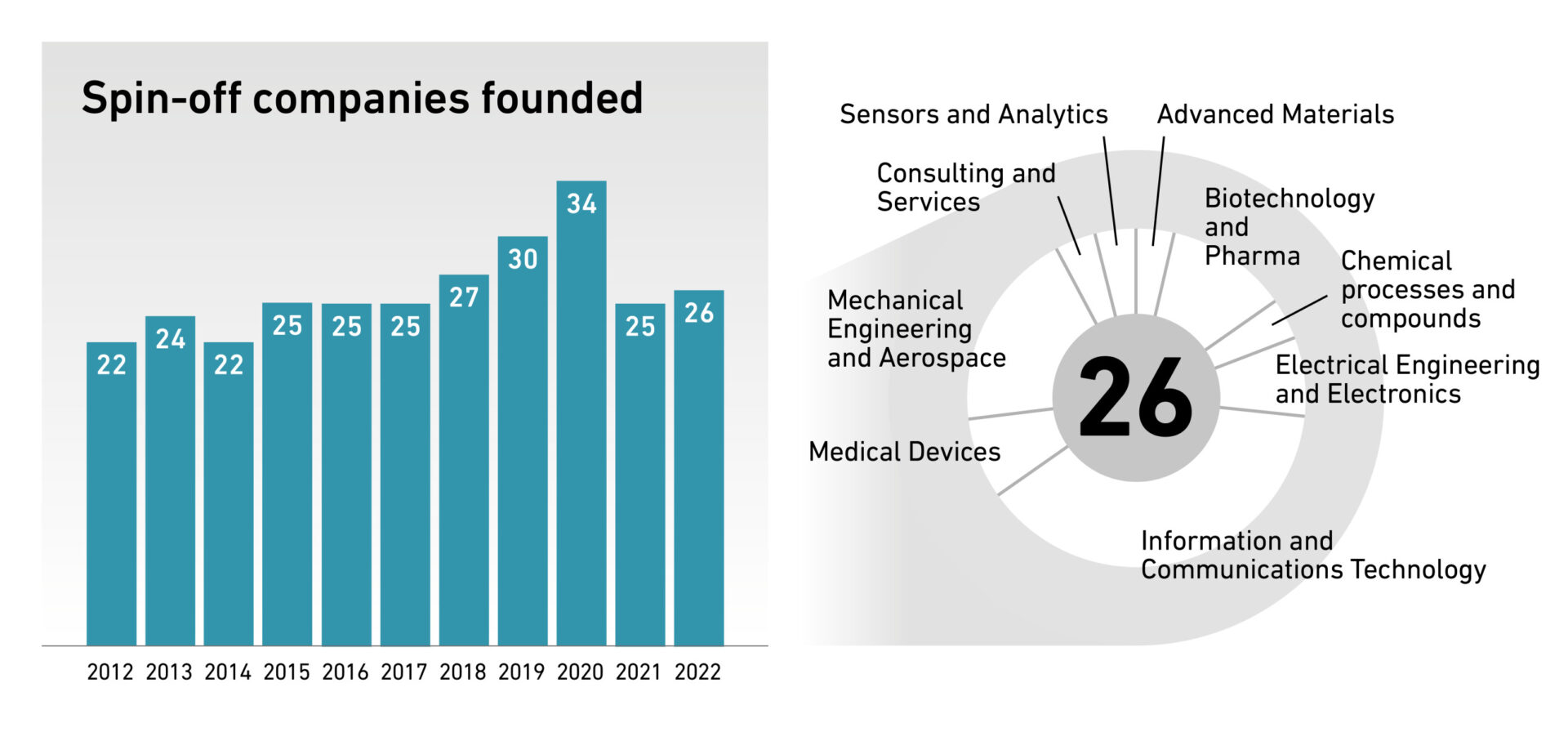
A grand total of 26 spin-offs were founded at ETH Zurich in 2022. Their businesses range from new cancer drugs and sustainable water bottles to digital mapping of urban traffic flows. The ETH spin-off family also welcomed three new unicorns and raised 1.2 billion Swiss francs in fresh capital.
Over the past year, ETH has seen the creation of 26 new spin-offs. These newly founded spin-offs cover a wide variety of fields and reflect the entire range of topics at ETH Zurich. The largest group (10) of the 2022 spin-offs are again focused on the IT and communications technology sector – a trend that has continued for several years. However, the problems these companies address are very different: while Calvin Risk AG offers a kind of artificial intelligence insurance, Cerrion AG uses AI and sensors to monitor and improve entire production processes. The ETH spin-off Transcality AG creates complex models, or digital twins, of traffic systems that make it possible to analyse a city’s traffic flows and simulate future scenarios.
A striking number of the new ETH spin-offs develop solutions for the healthcare sector. Three young companies are working on novel cancer drugs or on improving existing therapeutics, while two others offer apps that help to reduce stress and increase mental and physical well-being. Another one is Kairos Medical AG, which develops biodegradable bone implants. These are able to stabilise bones during healing, but – unlike conventional metal screws – they then dissolve in the body over time.
No fewer than four of the new spin-offs came to life in the Student Project House – ETH’s ideas workshop for its students. One such spin-off is Bottleplus, which produces a sustainable water bottle that can be used to make carbonated water on the go. Another is AtlasVR AG, which provides virtual reality technology for professional training programmes. “We want society to benefit from our research findings and innovations as quickly as possible. I’m enormously pleased that the Student Project House is succeeding in encouraging students to pursue their ideas and bring them to market,” says Vanessa Wood, Vice President for Knowledge Transfer and Corporate Relations at ETH Zurich. To further promote entrepreneurship among students and get schoolchildren excited about STEM subjects, ETH also entered into a strategic partnership with UBS in summer 2022.
Investment in ETH spin-offs also saw positive development last year. The companies raised around 1.2 billion Swiss francs – more than ever before. Three ETH spin-offs also attained unicorn status in 2022: the term refers to start-ups that are so promising that their market value exceeds one billion dollars even before they go public. These three companies are Scandit, which enables fast scanning even under difficult conditions, as well as Southpole and Climeworks, both of which are dedicated to the fight against climate change.
There were also a number of successful acquisitions: for example, the spin-off Adresta was bought by Bucherer, Animatico was acquired by Nvidia, and FGen was taken over by Ginko Bioworks. Vertical farming herbs from ETH spin-off Yasai also found their way onto Coop shelves in 2022, and Synhelion announced a strategic collaboration with Swiss International Air Lines. “It’s important for ETH that good technologies and ideas give rise to companies with growth potential and thus create new jobs. In this way, the success of our spin-offs becomes the success of Switzerland,” says Vice President Vanessa Wood.
Author: ETH-News
Image source: ETH Zurich
You need to load content from reCAPTCHA to submit the form. Please note that doing so will share data with third-party providers.
More InformationYou are currently viewing a placeholder content from Turnstile. To access the actual content, click the button below. Please note that doing so will share data with third-party providers.
More InformationYou are currently viewing a placeholder content from Vimeo. To access the actual content, click the button below. Please note that doing so will share data with third-party providers.
More InformationYou are currently viewing a placeholder content from YouTube. To access the actual content, click the button below. Please note that doing so will share data with third-party providers.
More InformationYou need to load content from reCAPTCHA to submit the form. Please note that doing so will share data with third-party providers.
More Information