News
Winterthur – Researchers at Zurich University of Applied Sciences (ZHAW) have developed a digital tool for sustainable construction. At dkon.ch, users can check the impact of individual construction decisions on the environment, costs and construction methods.
(CONNECT) The ZHAW has put its dkon.ch platform online. This enables students, specialists and interested parties to analyze, compare and develop building constructions themselves. According to a statement from the university, this digital tool provides them with information on the impact of individual design decisions on the environment, costs and construction methods. Users can disassemble, rotate and reassemble components in virtual space.
This reveals the materials that make up a construction and how they interact. By linking to ecological assessment data, variants can be compared with each other in a targeted manner. According to the ZHAW, this opens up new possibilities in planning: "If you want to reduce the use of concrete or test alternative materials, for example, you can directly compare different solutions. Changes in the construction become immediately visible and their effects understandable."
According to the information provided, a special feature of this platform is the integration of real reference buildings. Their designs, materials and construction processes can be analyzed in detail. "dkon.ch creates a direct link between teaching and application," says Andri Gerber, Project Manager and Co-Head of the ZHAW Institute of Constructive Design. "Knowledge is not imparted in isolation, but is made tangible in the context of real and concrete construction projects."
The platform is also helpful for specialists who have to integrate complex requirements and develop sustainable solutions, Gerber continues. That is why dkon.ch is "a tool that can be used both in training and in professional practice". ce/mm

With dkon.ch, users can assess the impact of their decisions regarding building design on the environment, costs and construction methods. Stock image: Nikguy/Pixabay
News
Zurich – Covalo has secured 3.5 million euros in a financing round. The beauty and personal care company intends to use the acquired capital to scale its platform into a data backbone for the entire personal care industry, supported by artificial intelligence.
(CONNECT) The Zurich-based start-up Covalo has secured a sum of 3.5 million euros in a financing round. According to a statement , the company intends to use the fresh capital to scale its platform for beauty and personal care ingredients into a data backbone in the industry. The financing round was led by Hi inov, with existing investors HTGF and seed + speed Ventures also participating.
Currently, 1500 suppliers and 6000 brands from 145 countries use the Covalo platform. The data required by the industry is currently available in various forms and must be painstakingly collected and updated by hand by the research and development departments. The Zurich-based company wants to create a central data infrastructure for the entire industry. "On average, it takes three to five years to bring a product to market. At the end of this process, 50 percent of product launches fail, costing the industry hundreds of billions every year," co-founder and co-CEO Yann Chilvers is quoted as saying in the press release. "Many companies are trying to find internal solutions to these challenges, but what they really need is a common data backbone that drives the industry and enables seamless data flows across teams and partners. Covalo is that backbone."
The company intends to use the acquired capital to strengthen its offering for large customers, introduce technologies supported by artificial intelligence and expand the platform's overall technology. The platform is also to be supplemented with functions for the central management of product and master data. ce/ww

Covalo aims to use fresh capital to scale its platform for beauty and personal care ingredients into a data backbone for the industry. Stock image: Curious_Collectibles/Pixabay
News
Zurich – Six Swiss banks and Swiss Stablecoin AG are testing possible use cases for a Swiss franc stablecoin in a secure, digital live environment. Their aim is to support the development of a national ecosystem for digital money and gain practical insights.
(CONNECT) Switzerland is to get a digital currency. To this end, six banks in the country have joined forces in an initiative, according to a UBS press release. Together, they are setting up a protected digital live environment, a so-called sandbox, to test selected use cases of a Swiss franc stablecoin in the second half of 2026. The background to this is the fact that regulated stablecoins are gaining ground worldwide as a secure and inexpensive means of payment.
In addition to UBS, PostFinance from Berne, Sygnum, Raiffeisen from St. Gallen, Zürcher Kantonalbank and Banque Cantonale Vaudoise from Lausanne are also involved. The technical infrastructure for issuing the digital franc is provided by Bern-based Swiss Stablecoin AG. According to the information provided, the sandbox is also open to other interested banks, companies and institutions that would like to contribute to the development of a CHF stablecoin.
The communication sets out three overarching objectives that the companies involved are pursuing. Its initiative is intended to support the development of a Swiss ecosystem for digital money, build new skills and experience in dealing with digital means of payment and gain practical insights.
Stablecoins are digital currencies whose value is linked to stable references such as the dollar, euro or gold. This is intended to avoid the volatility of traditional cryptocurrencies. Digital money serves as a bridge between traditional money and the crypto ecosystem. It is often used for payments, trading and storing value. ce/mm

Six Swiss banks plan to test use cases for a Swiss franc-pegged stablecoin. Stock image: softcodex/Pixabay
News
Zurich/Winterthur – The Swiss Excellence Foundation is looking for applicants for the Product Award 2026. Two prizes will be awarded for SMEs and start-ups. Interested parties can apply until May 15th. The award ceremony will take place on September 17th at Technopark Winterthur.
(CONNECT) The Swiss Excellence Foundation, based in Zurich, is inviting SMEs and start-ups to submit their innovative products for this year's Product Award 2026. Winning the award gives the companies publicity and serves as a springboard for further success, according to a press release.
Two different product awards will be presented for SMEs and start-ups. The assessment is based on innovation content, value creation potential and the quality of the business model and marketing concept. The product must have an outstanding innovative novelty and be clearly different from existing solutions. In addition to the criterion of sustainability, the marketing concept, which is based on a realistic business model, should also be convincing.
The award winners receive the right to label their product with the "Swiss Excellence Product Award". The award ceremony will take place on September 17th, 2026 at Technopark Winterthur. Applications can be submitted until May 15th, 2026. ce/ww
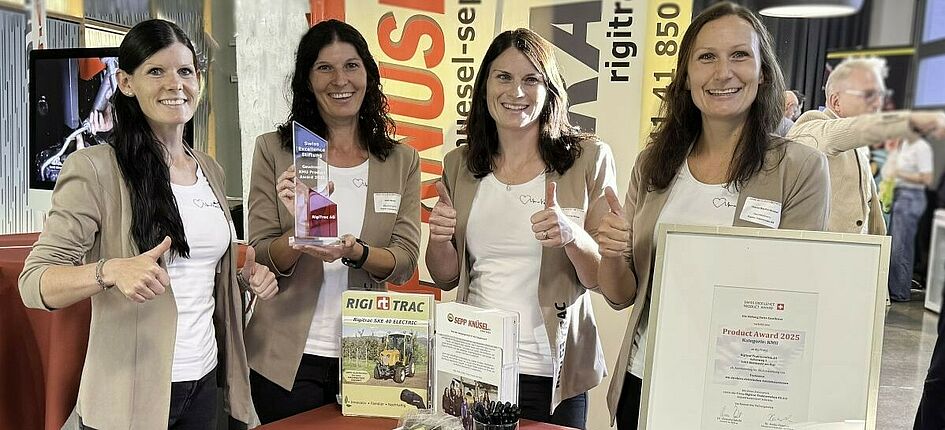
The four sisters Doris, Edith, Ruth and Theres (from left to right), representing the second generation of the Knüsel founding family, received the Swiss Excellence Product Award for RIGITRAC in 2025. Photo: courtesy of RIGITRAC Traktorenbau AG
News
Dübendorf ZH/Zurich- Researchers at the Swiss Federal Laboratories for Materials Science and Technology (Empa) are investigating micrometer-sized blood clots. By investigating the structure and size, they want to draw conclusions about the risk of strokes and corresponding diseases.
(CONNECT) Researchers at the Transport at Nanoscale Interfaces Laboratory of the Swiss Federal Laboratories for Materials Science and Technology (Empa) in Dübendorf are investigating micrometer-sized blood clots. Peter Nirmalraj and his team hope to draw conclusions about the risks of strokes, post-Covid diseases and rare forms of dementia by studying the smallest coagula, according to a press release.
Empa researchers are using imaging and various measurement methods to examine the shape, size and composition of blood clots from stroke patients. These investigations are being carried out jointly with Susanne Wegener's group at the University of Zurich (UZH). In addition to analyzing the samples, the effects of various medications on the blood clots are also investigated. The collected data is stored on an open source platform to enable other scientists to access the research results.
The current project is supported by the Peter Bockhoff Foundation, the Theodor Naegeli Foundation, the Immanuel and Ilse Straub Foundation and two other foundations, according to the press release. ce/ww
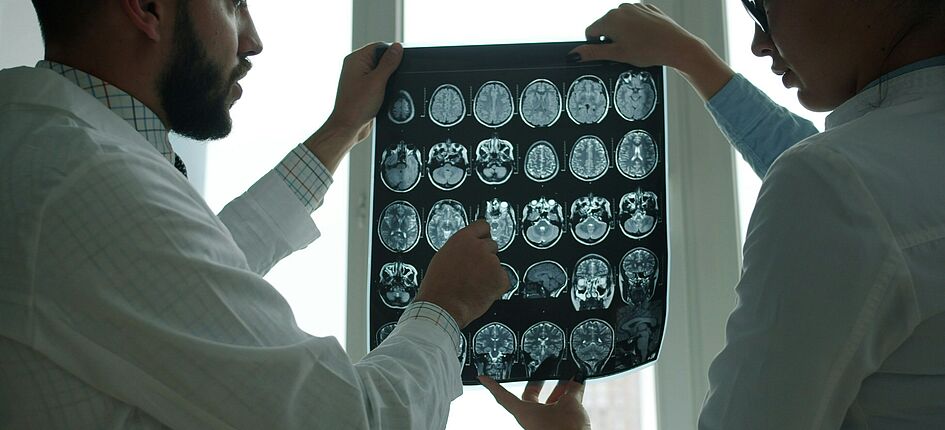
Researchers at the Transport at Nanoscale Interfaces Laboratory at the Swiss Federal Laboratories for Materials Science and Technology (Empa) in Dübendorf are investigating micrometre-sized blood clots. Stock image: Vitaly Gariev/Unsplash
News
Zurich/Houston – The University of Zurich is one of 34 institutions worldwide that will provide NASA with data on the trajectory of the Orion space capsule as it orbits the moon. To do this, a lecturer and his students use a radio telescope that he has set up on the roof of the physics building on the Irchel campus.
(CONNECT) During the Artemis 2 moon mission, the University of Zurich (UZH) is taking part in a test run for which NASA has selected 34 institutions worldwide. The North American space agency wants to find out whether it can support commercial providers, universities and private organizations in tracking the trajectory of satellites and space capsules. The incoming data is not used for the current mission. Instead, NASA is concerned with creating a resilient ecosystem for future missions, UZH quotes the deputy coordinator of NASA's Space Communication and Navigation Program in its report.
It is thanks to Achim Vollhardt that UZH was selected for NASA's test run in this regard. Last year, the lecturer at the Institute of Physics and head of the electronics workshop set up a radio telescope on the roof of the physics building "to give students the opportunity to work hands-on with real data". Some students were "really enthusiastic about it", Vollhardt continued. "That's why the ulterior motive was to pick them up on this interest." He didn't know at the time that NASA would be looking for participants for this program.
The UZH radio telescope can receive signals from the space capsule for five hours a day. The students will use this data to calculate the trajectory of the Orion space capsule. Because these have to be balanced again and again, his team "will also be able to measure and track some orbit corrections during the course of the mission," says Vollhardt. He has advertised several bachelor theses for the processing of the raw data. Among other things, they have to be cleaned of noise and saved in a special format. ce/mm

During the Artemis II lunar mission, UZH is taking part in a NASA test run to provide data on the spacecraft’s trajectory using its radio telescope. Image: Ben Smegelsky/NASA
News
Schlieren ZH – Surgical Fusion Technologies has received 1.2 million Swiss francs from Innosuisse to further develop its sports medicine surgery method. The medtech company uses an ultrasound generator to provide bioresorbable anchors that connect soft tissue to the bone.
(CONNECT) The Swiss Innovation Agency Innosuisse is supporting Surgical Fusion Technologies GmbH with a grant of 1.2 million Swiss francs. According to a statement from the medtech company based in the Bio-Technopark Schlieren-Zurich, this will accelerate the development of next-generation solutions for soft tissue bone fixation. These are intended to improve surgical results in sports medicine and orthopaedic procedures.
The name of the project is Aligned Fibers for Ultrasonically Bioactivated Implants (AFUBI). It involves as project partners both the Institute for Materials Engineering and Plastics Processing at the OST - Eastern Switzerland University of Applied Sciences, as well as the three institutes of the University of Applied Sciences and Arts Northwestern Switzerland for Polymer Nanotechnology, Polymer Technology and Chemistry & Bioanalytics.
The AFUBI project introduces a fixation concept based on ultrasound-activated, fully bioresorbable anchors that fuse directly with the cancellous bone during implantation. The controlled release of bioactive bioglass fibers via the company's own SupraFusion platform is intended to accelerate bone integration. By liquefying the implant surface locally using ultrasound, the technology enables micro-invasive anchoring with less bone trauma compared to current anchors.
"This extremely welcome grant from Innosuisse is an important endorsement of our technology and its potential to redefine how bioresorbable implants connect to bone," said Chief Technology Officer Jörg Mayer. "The AFUBI project enables us to further develop a minimally invasive fixation approach that combines mechanical performance with biologically active interfaces." ce/mm
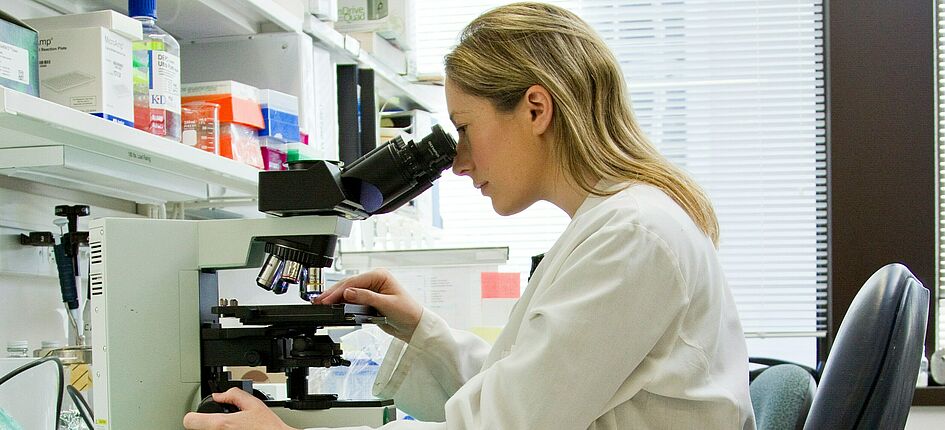
The Swiss innovation agency Innosuisse is supporting the medtech company Surgical Fusion Technologies GmbH with a grant of 1.2 million Swiss francs. Stock image: National Cancer Institute/Unsplash
News
The current issue of the FRZ Zurich Airport Region magazine focuses on the rapid development of information and communication technologies and artificial intelligence. The focus is particularly on the increasing fusion of physical infrastructure and digital intelligence, which is having a significant impact on the region’s economic development.
Vertical AI and new dynamics
A key trend is the transition from general AI applications to industry-specific solutions. This so-called vertical AI enables customized applications for specific industries such as construction or finance. At the same time, no-code platforms significantly accelerate software development and further drive the speed of innovation.
Strong location and targeted investments
Technological development is complemented by strong regional roots. A significant milestone is the secured financing of CHF 445 million for the Switzerland Innovation Park Zurich in Dübendorf. This will create the basis for the targeted expansion and long-term strengthening of research and development in the region.
Focus on network development and quality
FRZ looks back on a successful 2025. With over 900 members and new initiatives such as the Sustainability Advisory Board and the digital Sustainability Navigator, the network continues to focus on quality rather than quantity and is strengthening its strategic orientation.
Review and generational change
A special focus is on the long-standing commitment of Thomas Peter, who has shaped the development of Kloten and the airport region for more than two decades. As a connecting personality between administration and business, he has made a significant contribution to making the airport region the vibrant and networked center it is today. A new chapter begins with the handover to his successor Marc Osterwalder.
Outlook - focus on construction and real estate
The next issue of FRZ Magazine is dedicated to developments in the construction and real estate sector. The focus is on current trends, sustainable construction methods and innovative projects in the Zurich airport region. Advertising deadline for the mag 02 issue is May 31st, 2026. Advertising in media in the Zurich Airport region
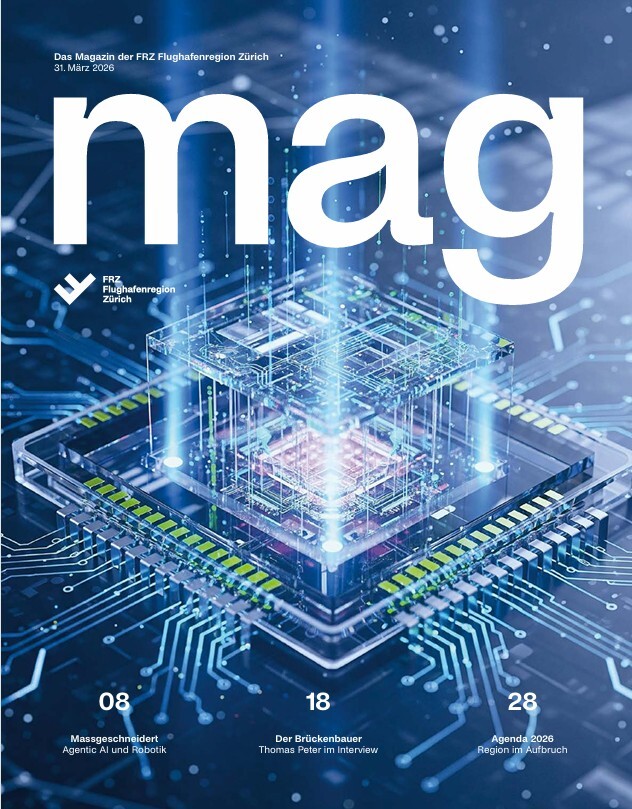
News
Zurich/San Mateo – The American drone manufacturer Skydio is expanding its international research and opening a development office in Zurich. The site is intended to further advance autonomous flight systems and utilizes the local robotics ecosystem.
(CONNECT) The American drone manufacturer Skydio has opened a research and development office in Zurich. Skydio Switzerland GmbH focuses on autonomous drone technology, particularly in the areas of artificial intelligence, navigation and perception, as detailed in a press release.
At the new location, a specialized team is working on the central challenges of autonomous systems. This includes the coordination of several units, navigation without a GPS signal and real-time decisions directly in the system. The decisive factors for the location were its proximity to the Swiss Federal Institute of Technology Zurich (ETH) and the University of Zurich, as well as access to highly qualified specialists.
The office will be headed by Davide Falanga, Director of Engineering, Autonomy Systems, who most recently worked at Skydio's headquarters in San Mateo, California, for over four years. "I'm looking forward to building a team in Zurich that pushes the boundaries of what drones can do in practice," he is quoted as saying. "It is gratifying to see that the local ecosystem continues to be able to translate cutting-edge research into concrete and impactful applications of aerial robotics," said Davide Scaramuzza, Professor of Robotics and Perception at the University of Zurich, where Falanga received his doctorate.
With the location in Zurich, Skydio is opening its second research office in Europe after Tampere in Finland. The American company focuses on applications in the military, police and industrial sectors. ce/as
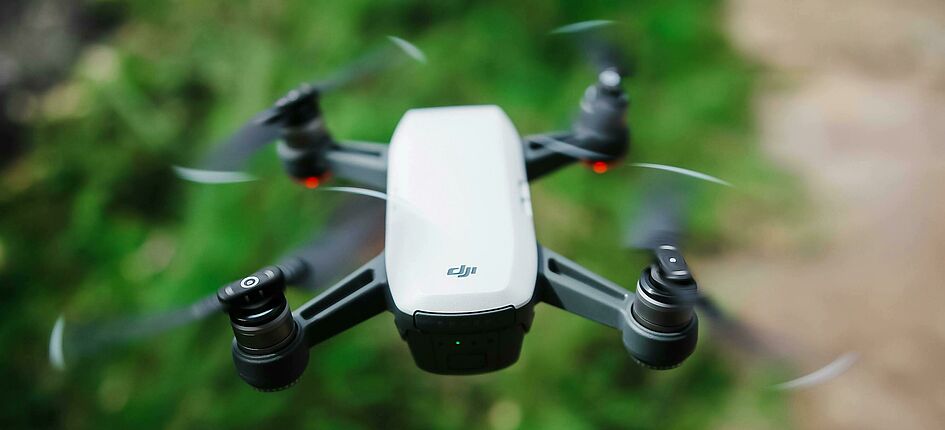
Skydio is expanding its international research activities and opening a development office in Zurich. Stock image: Pok Rie/Pexels
News
Uetikon am See ZH – Delta Labs has received early financing of 4.4 million euros. The University of Zurich spin-off has been offering its Elaiia platform for six months. This allows companies to simulate how target groups will react to products, strategy and communication.
(CONNECT) Delta Labs has raised 4.4 million euros in an early financing round. Two German venture capital companies have invested: Cusp Capital from Essen and the Berlin-based Auxxo Female Catalyst Fund. The spin-off of the University of Zurich (UZH) founded by CEO Dr. Cindy Candrian and CPO Dr. Anne Scherer in 2022 will thus take the next step, according to a press release. Scherer is a former assistant professor in quantitative marketing at UZH, Candrian completed her doctorate with a dissertation on the relationship between humans and artificial intelligence (AI). Delta Labs was already included in the Forbes 30 Under 30 list in 2024.
Delta Labs launched Elaiia six months ago. This "self-service platform" is based on a "rigorous methodology" for AI-supported customer simulations. With Elaiia, teams can use calibrated customer segments based on real and company-specific data to simulate how their customers in a particular country or segment are likely to react before taking costly product, pricing, communication and strategy measures. Elaiia is intended to replace time-consuming and costly social and market research methods such as surveys and focus groups.
As the two founders explain, they set up Delta Labs on the basis of their research experience. To understand and predict how customers will react to decisions, they developed their methodology, which incorporates their expertise in the fields of market research, AI-powered decision making, quantitative modeling and the science of human-technology interaction. According to UZH , Delta Labs aims to combine the findings from academic research with real business requirements in industry. Human values should play a central role in the use of AI as part of ethics. ce/mm

Delta Labs has raised €4.4 million in a seed funding round. Stock image: Ketut Subiyanto/Pexels
News
Kemptthal ZH – Katadyn presents its new Explorer water filter series. These portable, modular devices are designed for expeditions and professional field operations. They combine ceramic filtration, activated carbon and virus removal.
(CONNECT) Katadyn presents its new generation of portable water filtration and purification devices. According to a company statement, the Explorer series is designed for expeditions, use in rough terrain and demanding professional field operations. The modular system combines ceramic filtration, activated carbon and virus removal. It was developed and is manufactured in the Lindau district of Kemptthal, the current headquarters of the company founded in 1928.
"Explorer builds on decades of experience in Katadyn filtration technology by combining the strongest features of several of our existing systems into one modular platform," said lead product developer Thomas Sambeth. "The aim was to develop a system that can be adapted to different environments and is also reliable and easy to maintain in the field."
The Explorer range comprises two configurations based on the same modular platform: The Explorer Microfilter combines a field-cleanable ceramic filter with activated carbon to remove bacteria, protozoa and particulates while improving taste, chlorine and odor levels. The Explorer Pro also features a hollow fiber membrane for virus removal, providing a complete three-stage cleaning system for environments where viruses may be present. It can be mounted on the Explorer Microfilter if required.
The ceramic filter filters up to 20,000 liters of water, the virus membrane used in the Explorer Pro filters up to 10,000 liters and the activated carbon cartridge filters 500 liters. This reduces taste, chlorine content and odors. Katadyn operates worldwide, has production facilities in Europe and the USA and employs over 220 people. ce/mm
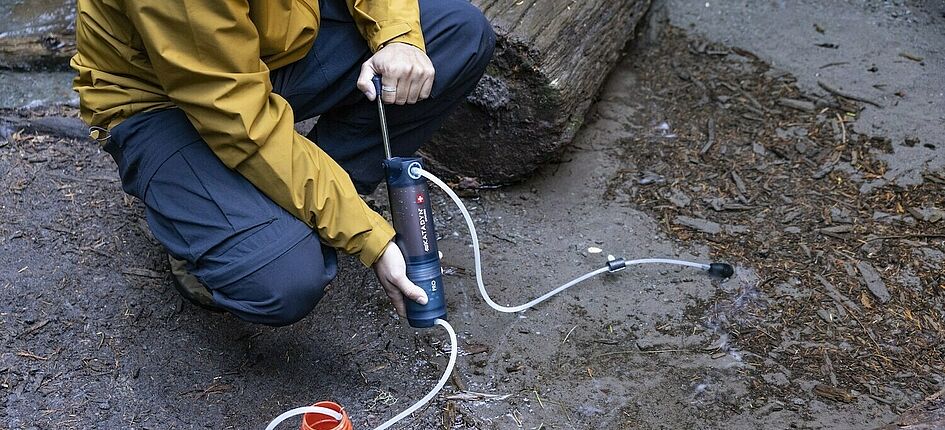
Katadyn presents its new generation of portable water filters and purification devices. Image: Katadyn Group AG
News
Zurich – The location marketing of the Greater Zurich Area (GZA) and the associated cantons were able to attract a total of 98 companies from abroad in 2025. 24 of them want to set up their headquarters in Switzerland, while 29 are conducting research and development here. The GZA annual report makes this clear.
(CONNECT) The Greater Zurich Area AG draws a positive conclusion in its Annual Report 2025. 98 foreign companies have heeded the call of the location marketing agency for the Zurich economic area and have decided to set up a new location in the association of nine cantons as well as the city of Zurich and the Winterthur region. 29 of them conduct research and development, 24 want to set up their headquarters in Switzerland. Together, they are planning 1295 new jobs over the next five years.
The GZA acts on behalf of the Greater Zurich Area Location Marketing Foundation, positions the Zurich economic region internationally and supports companies wishing to relocate here. She works particularly intensively on the focus ecosystems of life sciences, artificial intelligence and robotics. "Innovation determines whether good jobs, entrepreneurial know-how and industrial expertise remain anchored in our region," says Chairman of the Board of Directors Dr. Balz Hösly in his foreword. "For a high-cost location like the Greater Zurich Area, this is not an option, but a strategic necessity."
Blockchain technology was the strongest focus industry in 2025 with 20 new companies, followed by biotech and pharma (15) and artificial intelligence (8). Many of these projects are in the fields of robotics, artificial intelligence, autonomous systems and food & agritech.
The Israeli food tech company Aleph Farms, for example, has chosen Kemptthal ZH as the base for its European activities. On site, it meets partners along the entire value chain: Givaudan, Migros Industrie and Bühler. Tik Tok opened an office in Zurich, where it is close to brands, agencies, media and people who create content for social media. The Canadian company Blockstream is expanding its Bitcoin infrastructure in Lugano with the establishment of its headquarters there and the acquisition of Elysium Lab. The Beijing-based company Baidu Apollo has chosen Zurich as its first European location for its robotaxis.
International visibility is also the aim of the Zurich AI Festival, which the GZA is jointly responsible for and will continue in 2026. At the same time, the integration of the canton of Aargau by 2027 is being prepared, according to GZA Managing Director Lukas Huber. In general, he emphasizes the role of the associated cantons in the development of the business location: "With their framework conditions, their clusters and their location development, they create the basis for this marketing to be successful. We do promotion - the cantons are excellent product managers." ce/mm

By 2025, the Greater Zurich Area will have attracted a total of 98 foreign companies, which plan to create 1,295 new jobs in the coming years. Stock image: Thirdman/Pexels
You need to load content from reCAPTCHA to submit the form. Please note that doing so will share data with third-party providers.
More InformationYou are currently viewing a placeholder content from Turnstile. To access the actual content, click the button below. Please note that doing so will share data with third-party providers.
More InformationYou are currently viewing a placeholder content from Vimeo. To access the actual content, click the button below. Please note that doing so will share data with third-party providers.
More InformationYou are currently viewing a placeholder content from YouTube. To access the actual content, click the button below. Please note that doing so will share data with third-party providers.
More InformationYou need to load content from reCAPTCHA to submit the form. Please note that doing so will share data with third-party providers.
More Information