News
Zurich/Berlin – Sandal manufacturer RESLIDES and the German cleantech company CleanHub have entered into a partnership to protect the world’s oceans. They want to collect 1 kilogram of plastic in coastal regions for every pair of sandals sold.
(CONNECT) RESLIDES GmbH has agreed a cooperation with the Berlin-based cleantech company CleanHub GmbH as of March 1, 2026. According to a press release, the plan is to collect 1 kilogram of plastic in coastal regions for every pair of sandals sold in order to minimize plastic pollution in the world's oceans.
As a plastic recycler, RESLIDES wants to make a further contribution to sustainability. "We use plastic because it is the best solution for the durability and functionality of our sandals. But we are aware that it is precisely this material that causes one of the biggest environmental problems worldwide," RESLIDES co-founder Benno Reichard is quoted as saying. CleanHub is setting up collection networks in coastal regions in countries such as Indonesia and India to collect plastic there. The sale of a pair of sandals finances the collection of 1 kilogram, according to the press release. The shoes are also designed for durability and recyclability.
RESLIDES has already launched a takeback program. The return of removed components is rewarded. Soles, straps and buckles are then separated and recycled according to type. In this way, RESLIDES closes the material cycle and "consistently implements the principles of the circular economy". ce/heg
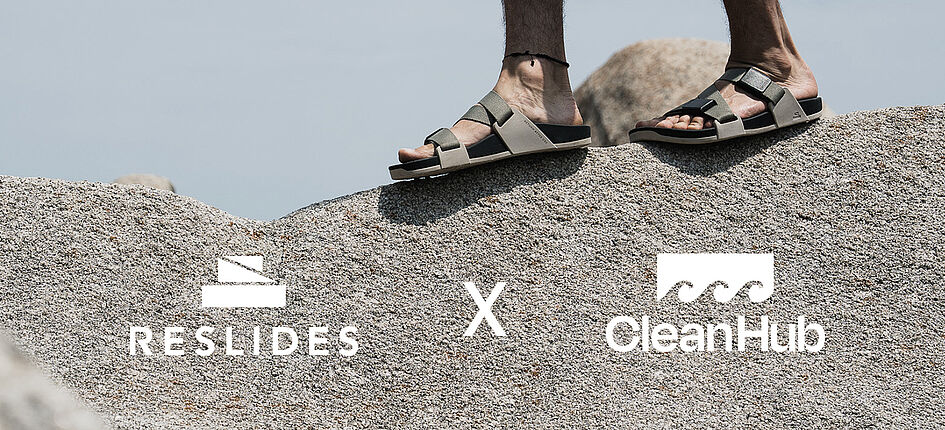
CleanHub will collect 1 kilogram of plastic from coastal regions for every pair of RESLIDES sandals sold. Image: zVg/tobinmeyers/RESLIDES GmbH
News
Thalwil ZH – U-blox launches ZED-X20D, a dual-antenna module with motion-independent GNSS heading determination. The ZED-X20D is an all-band GNSS heading module for high-precision applications. Areas of application include precision agriculture, unmanned aerial vehicles, autonomous machines, maritime applications and robotic navigation.
(CONNECT) U-blox announces the launch of its ZED-X20D all-band GNSS heading module. The module is based on the proprietary Allband X20 high-precision technology from the provider of positioning and short-range communication solutions for the automotive, industrial and consumer goods markets.
The ZED-X20D is a dual-antenna solution that enables robust RTK (Real-Time Kinematic) positioning in the centimeter range as well as motion-independent GNSS-based heading determination. The module is aimed at high-precision applications in the mass market. Areas of application include precision agriculture, unmanned aerial vehicles (UAVs), autonomous machines, maritime applications and robotic navigation. All GNSS constellations are supported on the L1, L2, L5 and L6 frequency bands on both antennas as well as the L-band. The u-blox PointPerfect service gives customers access to a comprehensive portfolio of correction options with regional and global coverage.
"With the introduction of the ZED-X20D, we are taking a decisive step towards the democratisation of high-precision GNSS technology. For our customers, this means that machines know exactly where they are and where they are pointing - even if they are not moving," Andreas Thiel, Co-CEO of u-blox, is quoted as saying.
The ZED-X20D will be presented at Embedded World 2026 in Nuremberg from 10 to 12 March. The first evaluation board for ZED-X20D will be available in April. The first engineering samples will be available in the late second quarter. ce/yes

U-blox launches ZED-X20D. Image: u-blox AG
News
Küsnacht ZH – The new Standortförderung Goldküste has held its first members’ lunch. Wim Ouboter presented his Micro Mobility Systems AG, which manufactures the Microlino.
(CONNECT) According to a press release, the Standortförderung Goldküste held its first members' lunch in Küsnacht. The Küsnacht entrepreneur Wim Ouboter presented Micro Mobility Systems AG, which he founded. Among other things, the company manufactures the electrically powered Microlino small car.
Ouboter also spoke about his planned strategies and cooperations as well as the continuation of his company by his two sons. He also addressed the political framework conditions. "As a manufacturer, we often don't have it so easy, especially when it comes to political support and the promotion of e-mobility in the small car sector. This is where we need courage, an understanding of innovative concepts and modern framework conditions that enable progress."
The Standortförderung Goldküste was founded in October. It will hold its general meeting on April 15th in Stäfa. Moritz Lechner, co-founder and Co-Chairman of the Board of Directors of Sensirion AG in Stäfa, will be speaking at the event. ce/ug
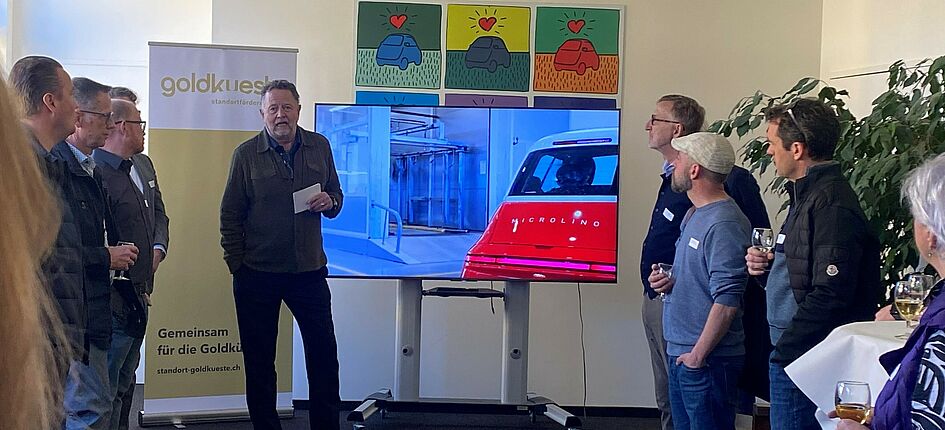
Entrepreneur Wim Ouboter discusses challenges and goals. Image: zVg/Standortförderung Goldküste
News
Zurich – Researchers at the Swiss Federal Institute of Technology in Zurich (ETH) have created a method for efficiently converting CO2 and hydrogen into methanol. They use isolated indium atoms as a catalyst and thus replace rare metals. Methanol can thus be produced without fossil raw materials.
(CONNECT) Researchers at ETH Zurich have developed a single-atom catalyst to make the production of methanol from CO2 and hydrogen more efficient. They use individual indium atoms on a carrier material made of hafnium oxide.
According to the university, the catalytic properties of atoms often change when they are isolated. In conventional catalysts, the metal atoms are usually bundled together in larger particles. In the new approach, each atom can participate directly in the reaction, which increases efficiency.
In order to anchor the individual indium atoms to the carrier, the interdisciplinary ETH team, together with colleagues from other research institutions, heated the starting materials to between 2000 and 3000 degrees Celsius and then cooled them down again quickly. This shows that single-atom catalysts can remain stable even under extreme conditions.
The single-atom catalyst also enables more precise investigations of the mechanisms, as the reactions of the individual atoms can be analyzed with fewer interfering signals.
The alcohol methanol is an important raw material for the chemical industry. Among other things, plastics, fuels and solvents are made from it. "The Swiss army knife of chemistry, so to speak," says Javier Pérez-Ramírez, Professor of Catalyst Engineering at ETH Zurich. He has been researching more efficient catalysts for the production of methanol from CO2 since 2010. ce/as

ETH researchers use individual atoms to produce methanol; pictured is the Atomium in Brussels. Symbolic image: ri1987/Pixabay
News
Dübendorf ZH/Kathmandu – Loft Dynamics AG is launching a helicopter training program in Nepal with the EU Aviation Safety Agency and Airbus Helicopters. Training with the company’s virtual reality flight simulators lasts one month. It is intended to help improve flight safety.
(CONNECT) Loft Dynamics AG is launching a new training program for helicopter pilots in Nepal. According to a statement, the aim of the joint initiative with the EU Aviation Safety Agency (EASA) and Airbus Helicopters is to improve flight safety in the mountainous country and reduce accidents.
The one-month training program takes place in Nepal's capital Kathmandu and uses a VR flight simulator of the type H125 from Loft Dynamics AG. All helicopter pilots spend four hours training in the simulator, practicing mountain flights and emergency scenarios in particular. The training is supplemented by Airbus Helicopters courses developed in accordance with International Civil Aviation Organization (ICAO) standards. "Our top priority is to lead the industry towards an accident-free future," said Arnd von Fabeck, Head of Aviation Safety Management and International Network at Airbus Helicopters, in the press release.
Helicopter traffic is central to Nepal, both for rescue and for transportation and tourism. Many remote regions can only be reached by air. The large differences in altitude and the changeable weather conditions pose particular challenges for pilots. "By bringing a compact, immersive VR training system directly to Nepal, pilots can train safely and more effectively for the very conditions in which they will later be flying," said Fabi Riesen, founder and CTO of Dübendorf-based Loft Dynamics AG, in the press release.
The initiative is part of the EU-South Asia Aviation Partnership Project. The program implemented by EASA aims to strengthen aviation safety and cooperation between authorities and industry in South Asia. ce/as

The flight simulator from Loft Dynamics is now also being used for helicopter training in Nepal. Image: zVg/Loft Dynamics AG
News
Zurich – Yapeal is making a strategic change to its management team. The Chairman of the Board of Directors, Dominik Bollier, will become the new CEO of the financial services provider. Michael Eidel is Chief Strategy & Partnership Officer. The company now wants to scale its embedded finance business.
(CONNECT) Zurich-based Yapeal has made a strategic change to its top management. The Chairman of the Board of Directors, Dominik Bollier, also holds the position of CEO, according to a press release. Former CEO Michael Eidel will take on the role of Chief Strategy & Partnership Officer.
Dominik Bollier has been working in the financial sector for over 20 years. According to the press release, he and a partner were most recently responsible for setting up an asset manager regulated by the Swiss Financial Market Supervisory Authority (FINMA). With around 100 employees, it managed assets worth several billion francs.
Michael Eidel took over as CEO of Yapeal in September 2024. Under his leadership, the integrated financial services division has been successfully established and expanded. In his new role, he will focus on the strategic expansion of the business and on value-adding partnerships at the financial services provider. The company was founded in 2018 and successfully completed a financing round in 2024 with a focus on embedded finance. Embedded finance is the integration of financial services into non-bank digital applications.
"I am very much looking forward to this task at the interface of finance and technology," Dominik Bollier is quoted as saying in the press release. "With its strong team, unique technology platform and FINMA license, Yapeal is in an excellent position to further scale the embedded finance business." Michael Eidel wants to use Yapeal's digital infrastructure to "promote innovative partner solutions and drive forward strategic projects that add value in the long term". ce/ww

Yapeal has made a strategic change in its senior management. Symbolic image: Rock Staar/Unsplash
News
Schlieren/Rüschlikon ZH/Geneva – Openversum GmbH from Schlieren, Ha Hu AG from Rüschlikon and WATALUX SA from Geneva received an IC Award at the 5th International Cooperation Forum. The three companies were honored for their innovative contributions to development aid.
(CONNECT) The 5th International Cooperation Forum (IC Forum) took place in Geneva from February 26th to 27th, the Federal Department of Foreign Affairs (FDFA) reported in a press release. At the forum, which is regularly organized by the Swiss Agency for Development Cooperation based at the FDFA, representatives from politics, business, research and civil society exchange views on issues relating to international cooperation for sustainable development. This year, the focus was on the growing pressure on the international humanitarian system, the FDFA reported in a press release.
One part of the forum program was the presentation of the IC Award. Openversum GmbH from Schlieren, Ha Hu AG from Rüschlikon and WATALUX SA from Geneva were awarded the prize for innovative business ideas from companies in the field of development cooperation. Openversum received the award for the development of a water filter that works without electricity. The company also offers support in setting up your own water business.
Ha Hu Ag from Rüschlikon specializes in the development of software for learning and entertainment purposes. The company received the IC Award for its work on an artificial intelligence platform that can be used to preserve and communicate languages. WATALUX from Geneva was honored for its water treatment systems. They are powered by solar energy and do not require the use of chlorine. ce/hs
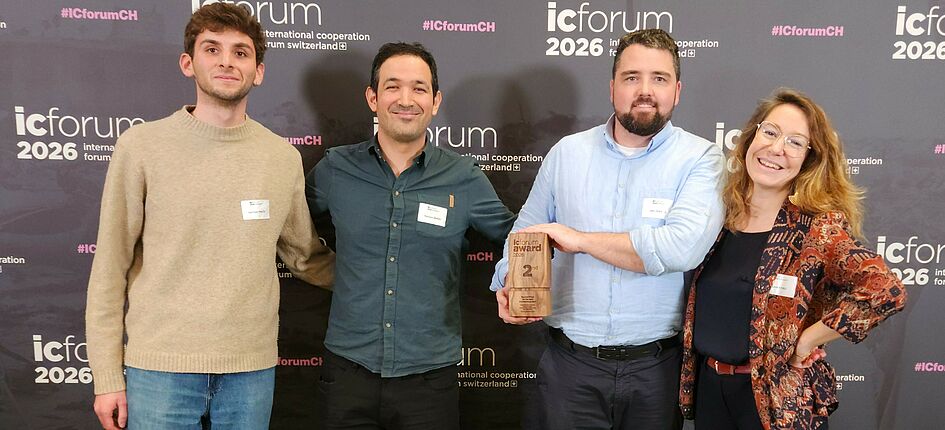
Openversum GmbH from Schlieren, Ha Hu AG from Rüschlikon and WATALUX SA from Geneva received an IC Award at the 5th International Cooperation Forum. Pictured is the WATALUX team. Image: zVg/WATALUX SA
News
Winterthur/Pisa – The Zurich University of Applied Sciences (ZHAW) is working together with the University of Sant’Anna in Pisa on innovative muscle models for the shoulder joint. Her silicone muscle is intended to help improve medical care for shoulder disorders.
(CONNECT) The Institute of Mechanical Systems (IMES) at the ZHAW and the University of Sant'Anna in Pisa are working together on novel muscle models that can be used to experimentally test natural joints and implants. The focus of the project is on the shoulder joint. "From a biomechanical point of view, the shoulder joint is much more complex than the hip or knee," says Molly Abraham, research assistant at IMES, in a press release issued by the ZHAW. "Muscles are central to joint function in the shoulder. The deltoid muscle in particular, as the strongest muscle in the shoulder area, plays a crucial role in controlling movement."
The shoulder simulator developed by the researchers consists of a shoulder blade, a joint and an upper arm. The centerpiece is a silicone replica of the deltoid muscle connected by cable to the joint's motors. Other muscles of the shoulder are simulated by pulleys connected to motors. "Since the start of the project, we have continued to develop the muscle model and have come closer and closer to the physiological conditions," explains Abraham.
In the project, the researchers investigated how changes in the volume of the deltoid muscle can reduce the forces required for movement. The knowledge gained could be used to better evaluate operations, implants and rehabilitation strategies. ce/hs
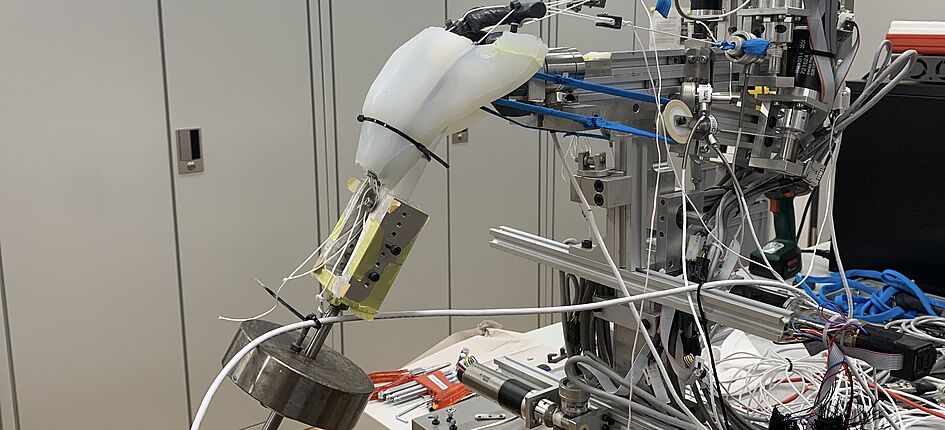
The Institute for Mechanical Systems (IMES) at ZHAW and the University of Sant'Anna in Pisa are collaborating on innovative muscle models that can be used to experimentally test natural joints and implants. Image: zvg/ZHAW Institute for Mechanical Systems (IMES)
News
Meilen/Schlieren ZH – The start-up promoter Venture Kick is supporting Fainite with 150,000 Swiss francs. The start-up from Meilen is working on an artificial intelligence (AI) platform for complex physics-based engineering analyses. Fainite intends to use the funds to expand the areas of application.
(CONNECT) Fainite AG receives 150,000 Swiss francs from the Schlieren-based start-up promoter Venture Kick. The start-up, which was founded around a year ago and is based in Meilen, is working on an AI platform for physics-based simulations, Venture Kick explains in a press release. It should enable engineers to speed up simulations and carry out sophisticated analyses "without neglecting the underlying physical principles".
Fainite's technology is geared towards complex tests that cannot be simulated realistically using general AI models. The start-up's AI platform accelerates and simplifies computer simulation workflows. In addition, new workflows can be set up in minutes and the results of simulations that have already been carried out can be reused.
Fainite intends to invest the funds donated by Venture Kick in the development of new fields of application, the establishment of a scalable platform and market entry activities. "Venture Kick has played a central role in enabling us to quickly transition from early validation to real industrial applications," Fainite CEO Alex Donzelli is quoted as saying in the press release. "The support, feedback and network were invaluable for the further development of our product and our go-to-market strategy." ce/hs
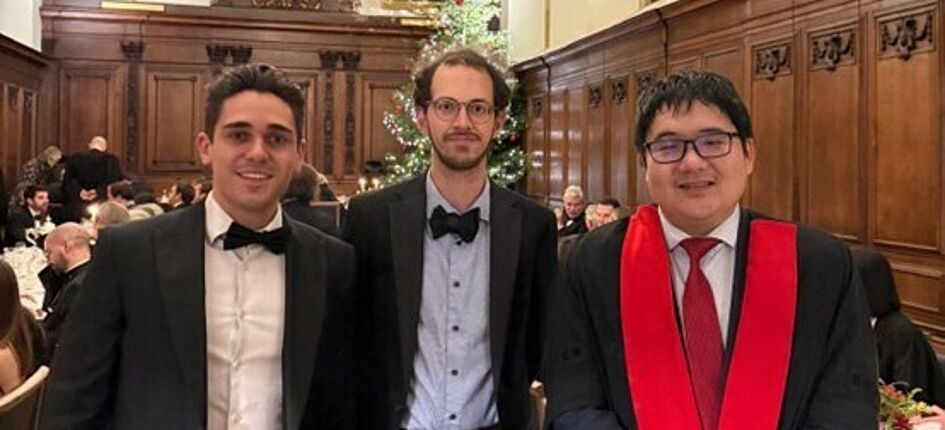
(from left to right) Alex Donzelli (CEO), Matthias Bonvin (ML Lead) and Prof. Burigede Liu (Chief Scientist) have received 150,000 Swiss francs from Schlieren-based start-up promoter Venture Kick for their company Fainite AG. Image: zVg/Venturelab Ltd.
News
Zurich/San Francisco – The San Francisco-based start-up Exa, which is active in the field of artificial intelligence (AI), has opened its first European office in Zurich. The background to this is Zurich’s position as a growing AI hub together with the Swiss Federal Institute of Technology. The search engine provider is looking for employees for the site.
(CONNECT) Exa from San Francisco in the US state of California is opening a location in Zurich, according to a press release. The company develops AI-based internet browsers. Exa claims to be the first search engine that is optimized to deliver exactly the information that users are looking for. The start-up sees itself as an applied AI laboratory that is developing a new neural approach for search technologies.
An important reason for the choice of location is Zurich's position as a fast-growing AI hub in Europe. Leading players in the industry such as Anthropic, OpenAI, Nvidia and Google DeepMind are already represented in the region. Thanks to the top university, the Swiss Federal Institute of Technology Zurich (ETH), the city and Switzerland in general - with the Swiss Federal Institute of Technology Lausanne (EPFL) - is also a magnet for AI talent, according to the company. The location in Zurich also enables Exa to serve European customers in the same time zone and to develop a better understanding of local markets.
Exa is currently looking for researchers and engineers in the fields of information retrieval and machine learning for the Zurich office. "To put together the best search team in the world, you have to meet them where they are in the world," CEO Will Bryk is quoted as saying. ce/ja

Exa explicitly cites the strength of the Swiss Federal Institute of Technology Zurich as one of the reasons for locating in Zurich; pictured is the main building. Image: Alessandro Della Bella/ETH Zurich
News
Winterthur/Zurich/Nottingham – Worn Again Technologies has put a textile-to-fiber accelerator into operation. With the pilot plant in Winterthur, the company aims to scale up the process of recycling polyester and cotton fabrics into new yarns and make it commercially viable.
(CONNECT) Worn Again Technologies, which has sites in Winterthur and Nottingham and is based in Switzerland with Worn Again Switzerland AG in Zurich, has put its textile-to-fiber accelerator into operation in Winterthur. With the successful recycling of used polyester and cotton textiles, the company wants to initiate the process towards commercial use, according to a press release.
With the Accelerator, the company has significantly improved its process chemistry and technical processes. With the solvents currently used, polyester and cotton fibers can be recovered in high purity. Technically, it has been possible to recover 95 percent of the solvents used and thus make the process more environmentally friendly. There are currently two expansion stages of operation. In the first, polyester is recycled into spinnable fibers. In a second stage, cellulose fibers and other cellulose products will be produced.
"The Accelerator is a decisive factor in the construction of our first commercial plant," Toby Moss, Chief Commercial Officer of Worn Again Switzerland, is quoted as saying in the press release. "Testing on this scale will allow us to expand our solutions to a wider range of raw materials, enabling us to maintain our pioneering role by recycling more material streams and building a growing portfolio of high-quality downstream product applications." With the successful test runs, the company is now trying to find industrial practice partners to commercialize the process. ce/ww
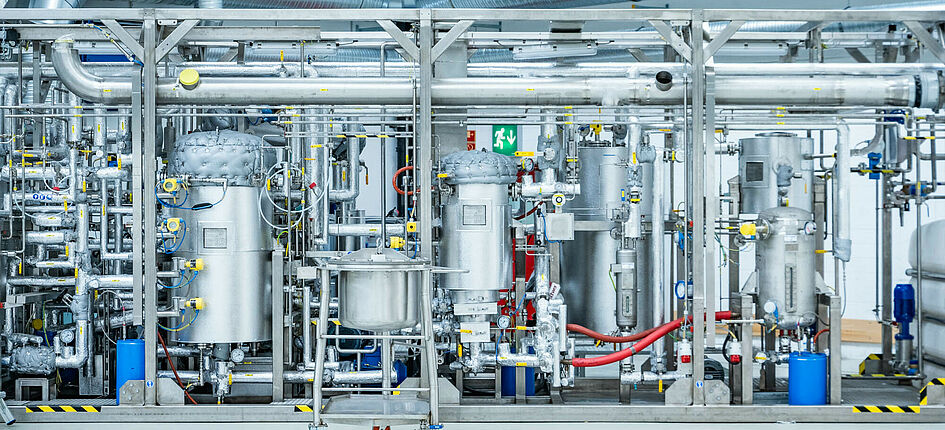
Worn Again Technologies has launched its textile-to-fibre accelerator in Winterthur. Image: zVg/Worn Again Switzerland AG
News
Dübendorf ZH – Researchers at the Swiss Federal Laboratories for Materials Science and Technology (Empa) have developed a flexible electrolyte based on silicone. It could enable better solid-state batteries and flexible rechargeable batteries. An industrial partner is now being sought for commercialisation.
(CONNCET) Researchers from the Functional Polymers department at Empa have developed a new type of electrolyte for solid-state batteries. It is based on a synthetic polymer from the group of polysiloxanes (silicones), Empa reports in a press release. The group led by Empa researcher Dorina Opris has succeeded in turning silicone, which is actually apolar, into a good ion conductor.
The great advantage of the new electrolyte lies in its elasticity. With conventional solid-state batteries, there is a risk that cavities will form when the electrons migrate from the anode, reducing the capacity of the battery. The silicone electrolyte developed by Empa can fill these cavities, but is also strong enough to prevent the build-up of dendrites. Such tree-like structures of lithium ions can form in batteries with liquid electrolytes and lead to short circuits.
In addition to improving solid-state batteries, the Empa researchers are also looking at the use of their electrolyte in flexible batteries: "Today's batteries for medical implants, such as pacemakers, are usually hard and uncomfortable for patients," Opris is quoted as saying in the press release. "Our polymer can serve not only as an electrolyte, but also as a binding material for the cathode." The researchers are currently working on improving the conductivity of their silicone electrolyte. At the same time, an industrial partner is being sought for the commercialisation of the technology. ce/hs
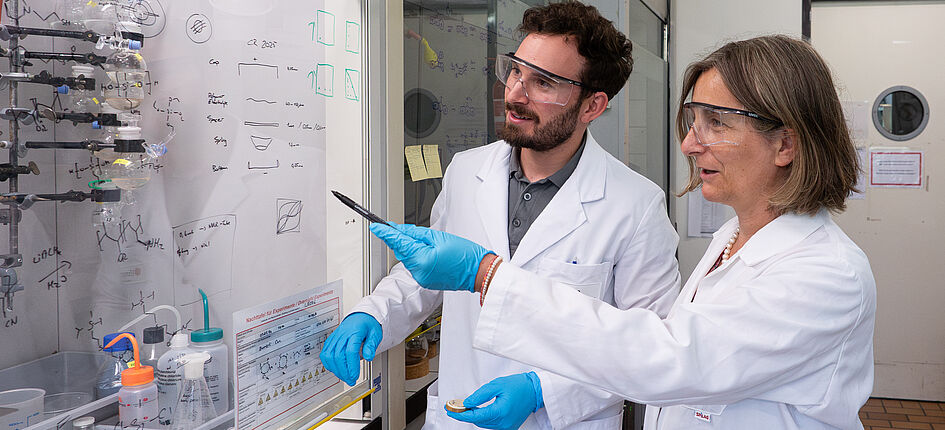
Dorina Opris (right) and Can Zimmerli have added functional groups to the silicone base, which make the polymer a good ion conductor without reducing its elasticity. Image: Empa
You need to load content from reCAPTCHA to submit the form. Please note that doing so will share data with third-party providers.
More InformationYou are currently viewing a placeholder content from Turnstile. To access the actual content, click the button below. Please note that doing so will share data with third-party providers.
More InformationYou are currently viewing a placeholder content from Vimeo. To access the actual content, click the button below. Please note that doing so will share data with third-party providers.
More InformationYou are currently viewing a placeholder content from YouTube. To access the actual content, click the button below. Please note that doing so will share data with third-party providers.
More InformationYou need to load content from reCAPTCHA to submit the form. Please note that doing so will share data with third-party providers.
More Information